
How Many Porta Potties Do I Need for OSHA Compliance?
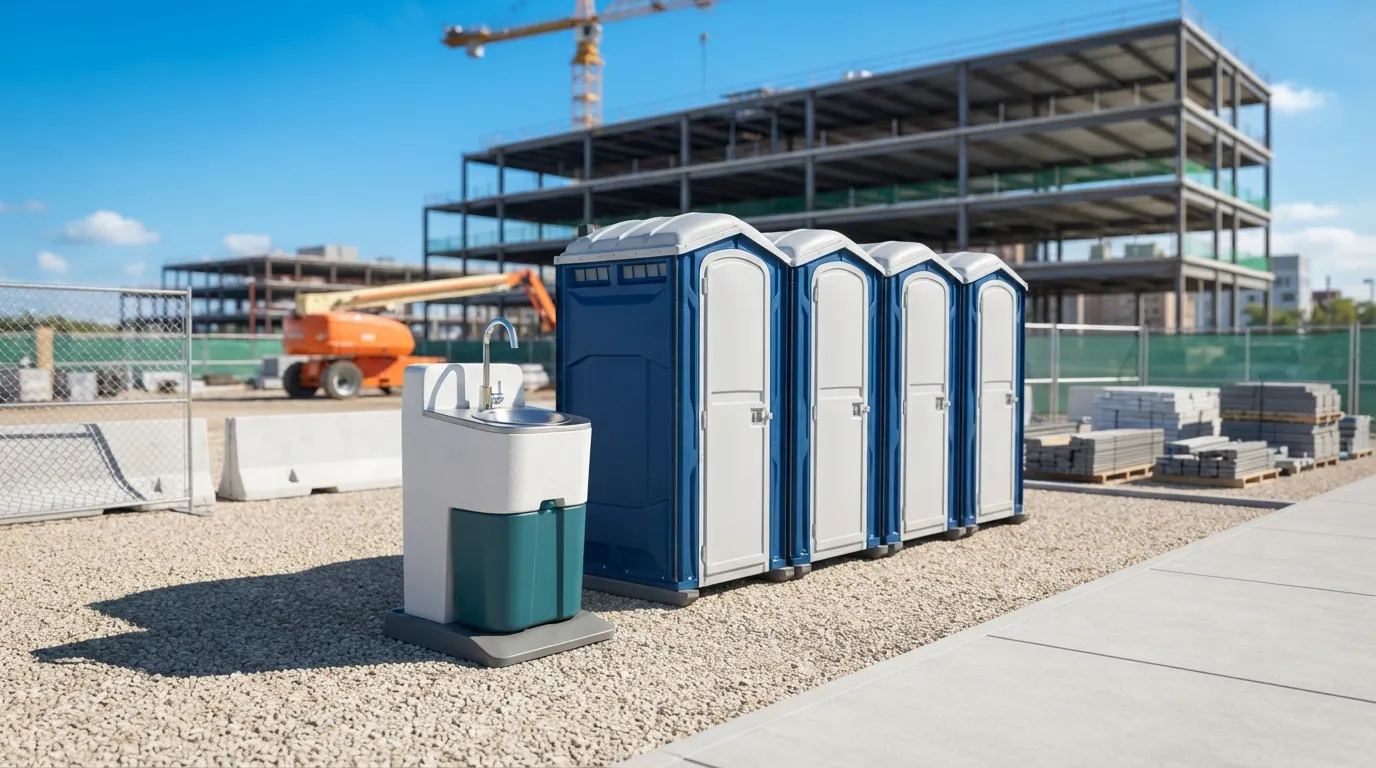
Start with the headcount on site at peak shift. Under OSHA 1926.51(c), a crew of 20 or fewer needs one toilet facility, full stop. Once you cross 20 workers, the math changes: one toilet seat plus one urinal per 40 people, and that ratio holds until you hit 200 workers, where it drops to one seat and one urinal per 50. A 15-person framing crew in Millcreek, 3.8 miles southwest of Erie, needs just one unit. A 60-person site downtown needs two toilets and two urinals at minimum. Erie general contractors often round up anyway, since a line at the only toilet on site burns labor hours fast. If you are still guessing at numbers, run through the how many porta potties do I need guide before you call for a quote, or just request a quote and let us count for you. For agricultural crews doing hand labor, note that 1928.110 sets a different standard: one facility per 20 workers, reachable within a quarter mile walk.
What Does OSHA Say About Handwashing and Water?
OSHA 1926.51(a)(1) requires an adequate supply of potable water at every place of employment, no exceptions for job size. That is separate from toilet counts, which fall under 1926.51(c) for general sanitation. If your Erie crew is spraying paint, coatings, herbicides or insecticides, 1926.51(f)(1) kicks in and requires washing facilities for that contaminant exposure specifically. It is not a blanket handwashing rule for every job site, so do not treat it that way. Under 29 CFR 1910.141(d)(2), any washing facility you do provide needs soap and towels or a hand-drying device. Hand sanitizer alone does not satisfy that standard. A lot of Erie contractors pair a handwashing station rental with their toilet order specifically to cover the (f)(1) contexts, painting crews, coating applicators, anyone spraying chemicals outdoors. A portable sink rental works the same way for food-adjacent trades. If you just need sanitizer stations for general foot traffic on an event site, that is a different product entirely, see hand sanitizer station rental.
Is Cal OSHA Different From Federal OSHA on Portable Toilets?
Yes, and it matters if your company works both Pennsylvania and California jobs. Cal OSHA portable toilet requirements for construction sites are stricter in a few areas, including distance from work areas and servicing frequency, and they are enforced under California's own state plan rather than federal 1926.51. Erie, PA falls under federal OSHA jurisdiction, so 1926.51(c)(1) is the ratio that governs local job sites, not the California standard. Contractors bidding out-of-state work should not assume Pennsylvania numbers travel. For Erie construction specifically, pair your toilet count with the broader construction site services checklist, since permits, temporary fencing, and light tower rental often get scheduled at the same time as sanitation.
Where Should Portable Toilets Be Placed on an OSHA Job Site?
Placement is about access, not just headcount. ADA Standards 213.2 requires that where you cluster single-user portable units, at least 5 percent must be accessible, and never fewer than one unit, so multi-unit Erie sites need to budget for an ADA accessible porta potty even at modest headcounts. That accessible unit needs a 36 inch clear route per ADA 403.5.1, a 32 inch door opening per 404.2.3, and a 60 inch turning circle inside per 304.3.1. OSHA 1926.202 also governs barricades near job site hazards, which matters if your toilets sit close to excavation or equipment staging. Keep units off active travel paths and on stable, level ground; ADA 302.1 requires firm, slip-resistant surfaces for the accessible unit's approach. A site in Harborcreek, 7.8 miles northeast of Erie, or one out toward Penn State Erie (Behrend), 6.1 miles east, still follows the same federal placement logic. For general guidance on where units go relative to entrances, dumpsters, and parking, see the porta potty placement guide. If you are also renting a roll-off dumpster rental or storage container rental for the same job, plan clearance for both, since a roll-off delivery needs about 60 feet of straight clearance behind the truck.
Search interest sometimes shows up as "portable toilet rental oshawa" or "storage container rental oshawa," but Oshawa is in Ontario, not near Erie, PA. If you landed here searching that term, Erie Porta Pros serves Erie and the surrounding towns listed on our service areas page, not Ontario.
What is the OSHA distance requirement for portable toilets?
OSHA's 1926.51(c) does not set an exact foot-and-inch distance from a work area, only that facilities be provided and accessible. Site-specific factors like ADA route width (36 inches under 403.5.1) and the general duty to keep walkways clear under OSHA 1926.25 govern practical placement more than any single number does.
Do OSHA rules apply to short-term rentals like weekend events?
Yes, if workers are on site under an employer, OSHA sanitation rules apply regardless of rental length. A one-day job still needs to meet 1926.51(c) ratios. For weekend event rentals without employees on the clock, check the event restroom rental page instead, since guest-count planning differs from OSHA worker ratios.
Does a small renovation crew need a portable toilet?
A crew of one or two still needs sanitation access under OSHA, though many use an existing building restroom if available and documented. For most residential jobs in Erie, contractors rent a standard unit anyway; see home renovation porta potty for typical setups on small crews.
What is the difference between a standard unit and an ADA unit?
A standard unit runs about 44 by 48 inches on the ground and 92 inches tall, sized for one user at a time. An ADA unit is larger inside to meet the 60 inch turning circle under ADA 304.3.1 and the wider door under 404.2.3. Compare both on the standard porta potty rental and ADA accessible porta potty pages.
Who enforces these rules on Erie job sites?
Federal OSHA enforces 1926.51 on Erie construction sites, since Pennsylvania operates under federal jurisdiction rather than a state plan. Site inspectors check toilet ratios under 1926.51(c), water supply under 1926.51(a)(1), and washing facilities where 1926.51(f)(1) applies to paint, coating, herbicide or insecticide work. Questions about a specific job should go through contact or a formal request a quote.
Next step
Get a delivery date
Tell us the address, the dates and the headcount. We size the order and confirm the route.